The model is built via backpropagation
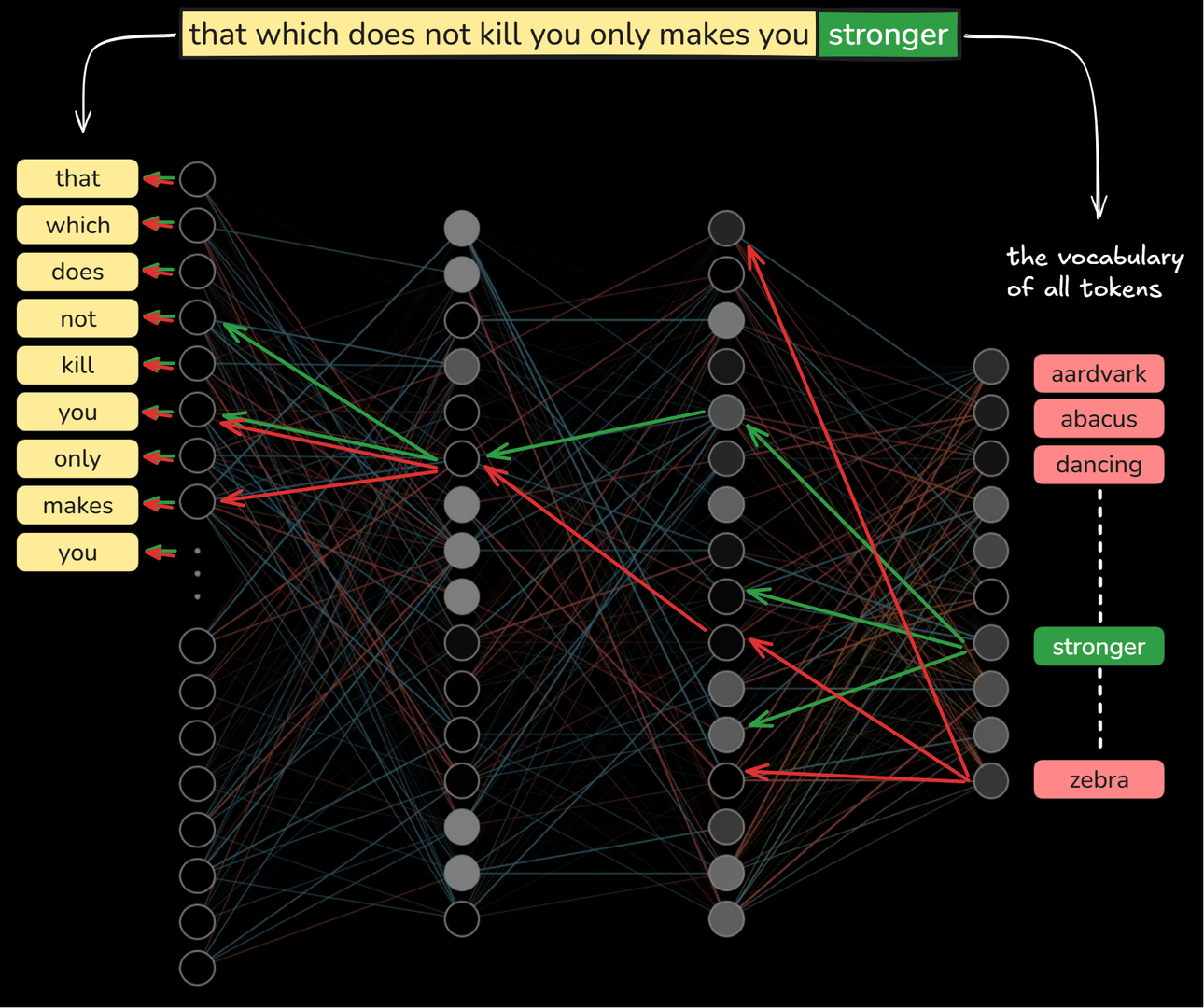
Now finally, here's how the model's neural-network weights and each embedding's 12288 values come into existence: by training on "all sentences in the world" and using an algorithm called backpropagation.
Let's go through it. It's a surprisingly simple idea.
Initially an untrained model's billions of neural-network weights and each embedding's 12288 numbers just start out random. The embeddings don't mean anything and the network can't predict anything correctly. Then we start training it like so.
Pick a training sentence. Let's say "that which does not kill you only makes you stronger". To keep it simple, let's just assume every word is one token.
The full sentence except the last token is passed through the full model network, all 96 layers. After billions of math-operations, the Transformer's final layer produces (say) 100,000 numbers, one number for each token in the vocabulary. Each of the 100,000 numbers represents the predicted probability for that particular token for this particular input. For an untrained model, these numbers will of course just be complete rubbish and random because all the little weights start out random.
But then:
For this training sentence, we know exactly what the expected next token should be: it should be "stronger". This means that for this sentence we want token "stronger" to be more probable and all other 99,999 tokens to be less probable - right?
So we do this:
All the little weights that lead to "stronger" are dialed up a small bit: yes, we want these paths to produce higher numbers so token "stronger" is more probable. Every little number on the way back that produced "stronger" gets a nudge up, all the way back through all the 96 layers, including the embedding-numbers themselves for tokens "that", "which", etc.
Likewise, all the 99,999 paths that produced any other token get dialed down a bit. No, we don't want "aardvark", "abacus", and "dancing" to be likely tokens to follow in this sentence.
That's a lot of math just for one sentence. Luckily, in practice this will actually train all "sub-strings" too, so the model also learns from this training sentence that the more likely token to follow "that" is "which", the more likely token to follow "that which" is "does", and so on.
Now, repeat that a gazillion times for the entire training corpus, and the network-weights and embeddings will end up with values that generally produce a suitable "likely next token" for all those trained sentences.
That's where the embeddings' 12288 numbers come from: the numbers we end up with from training just happen to work well in predicting all those training-sentences, together. And that's why we don't know what dimension 2033 actually is or what the number actually means: it's not "playful-ness" but just some number that makes the probabilities work out optimally.
What still blows my mind is how that relatively simple process can produce a prediction-machine that can construct sentences that are practically indistinguishable from human thinking.